
How to Use
Computer-Generated Transcriptions
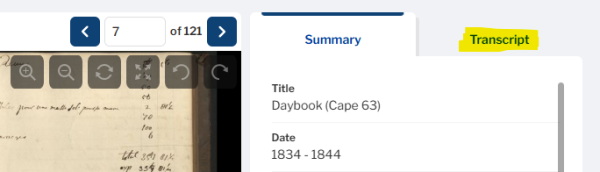
Computer-generated transcripts were created for all handwritten pages using HTR (Handwritten Text Recognition), which is helpful but imperfect. The uncorrected transcripts allow for keyword searching across the records, but misspellings and other errors mean not all instances of a word written in a record may be found when searching them. To read the computer-generated transcript, click the Transcript tab in the upper-right corner of a page.
Manual Transcriptions and Translations
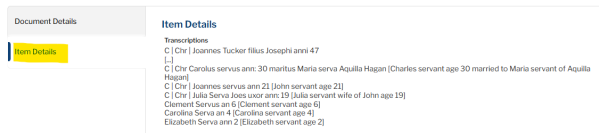
A list of individual pages with references to enslaved or free persons can be found in the Description field of each record. To enhance accessibility to these references, the Digital Archivist at DePaul Special Collections and Archives read through each record and located, transcribed, and corrected them by hand. The Digital Archivist also translated the letters in the Rev. Charles L. Souvay, C.M. papers. The manual transcriptions can be found by clicking the Item Details tab below the Document Details tab on a specific page.
Transcription Conventions
- An ellipsis in square brackets [...] indicates that text has been skipped.
- [sic] stands for "spelling is correct", indicating words misspelled by the original writer and not as a result of transcription.
Searching
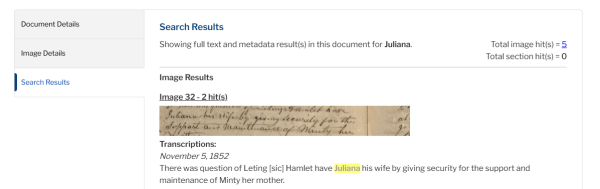
When performing a text search, hits found in both the HTR transcript and manual transcriptions will be counted in the Search Results for each record.
Metadata
The terminology employed in the metadata has been drawn from Library of Congress Subject Headings, consultation with Kelly Schmidt, Reparative Public Historian and Special Collections Management Research Associate at Washington University, and the descriptive model developed by On These Grounds, a collaborative effort between archival professionals and historians to create an ontology for institutions of higher education seeking to address the legacies of their involvement with slavery.
Collection Guide
A link to the full Finding Aid of each collection, which includes undigitized material, may be found in the Link to Finding Aid field in each record's metadata, in the Summary tab.
s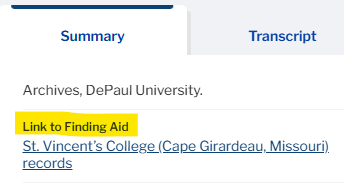
How to Use
Computer-Generated Transcriptions
Computer-generated transcripts were created for all handwritten pages using HTR (Handwritten Text Recognition), which is helpful but imperfect. The uncorrected transcripts allow for keyword searching across the records, but misspellings and other errors mean not all instances of a word written in a record may be found when searching them. To read the computer-generated transcript, click the Transcript tab in the upper-right corner of a page.
Manual Transcriptions and Translations
A list of individual pages with references to enslaved or free persons can be found in the Description field of each record. To enhance accessibility to these references, the Digital Archivist at DePaul Special Collections and Archives read through each record and located, transcribed, and corrected them by hand. The Digital Archivist also translated the letters in the Rev. Charles L. Souvay, C.M. papers. The manual transcriptions can be found by clicking the Item Details tab below the Document Details tab on a specific page.
Transcription Conventions
- An ellipsis in square brackets [...] indicates that text has been skipped.
- [sic] stands for "spelling is correct", indicating words misspelled by the original writer and not as a result of transcription.
Searching
When performing a text search, hits found in both the HTR transcript and manual transcriptions will be counted in the Search Results for each record.
Metadata
The terminology employed in the metadata has been drawn from Library of Congress Subject Headings, consultation with Kelly Schmidt, Reparative Public Historian and Special Collections Management Research Associate at Washington University, and the descriptive model developed by On These Grounds, a collaborative effort between archival professionals and historians to create an ontology for institutions of higher education seeking to address the legacies of their involvement with slavery.
Collection Guide
A link to the full Finding Aid of each collection, which includes undigitized material, may be found in the Link to Finding Aid field in each record's metadata, in the Summary tab.
s
Acknowledgements
The research behind the Slavery Acknowledgement Project and the creation of this site primarily occurred between 2023 and 2025. Special thanks to Dr. Lori Pierce, Associate Professor of African and Black Diaspora Studies, and Dr. Margaret Storey, Associate Dean of the College of Liberal Arts and Sciences (2017-2025) and Professor of History, who served as co-chairs of the Historical Research subcommittee of the Task Force to Address the Vincentians' Relationship to Slavery commissioned by DePaul University President Gabriel Esteban in 2021.
Efforts were made to manually transcribe references to known enslaved and free persons in the metadata of individual records with research and support from the following: Dr. Margaret Storey; Claire Marshall, Digital Archivist; Morgen MacIntosh Hodgetts, Senior Archivist and Coordinator of Archival Operations; and students Stephanie Crean, Hannah Kornblut, Isabella Melani, and Tess Wells.
Acknowledgements
The research behind the Slavery Acknowledgement Project and the creation of this site primarily occurred between 2023 and 2025. Special thanks to Dr. Lori Pierce, Associate Professor of African and Black Diaspora Studies, and Dr. Margaret Storey, Associate Dean of the College of Liberal Arts and Sciences (2017-2025) and Professor of History, who served as co-chairs of the Historical Research subcommittee of the Task Force to Address the Vincentians' Relationship to Slavery commissioned by DePaul University President Gabriel Esteban in 2021.
Efforts were made to manually transcribe references to known enslaved and free persons in the metadata of individual records with research and support from the following: Dr. Margaret Storey; Claire Marshall, Digital Archivist; Morgen MacIntosh Hodgetts, Senior Archivist and Coordinator of Archival Operations; and students Stephanie Crean, Hannah Kornblut, Isabella Melani, and Tess Wells.